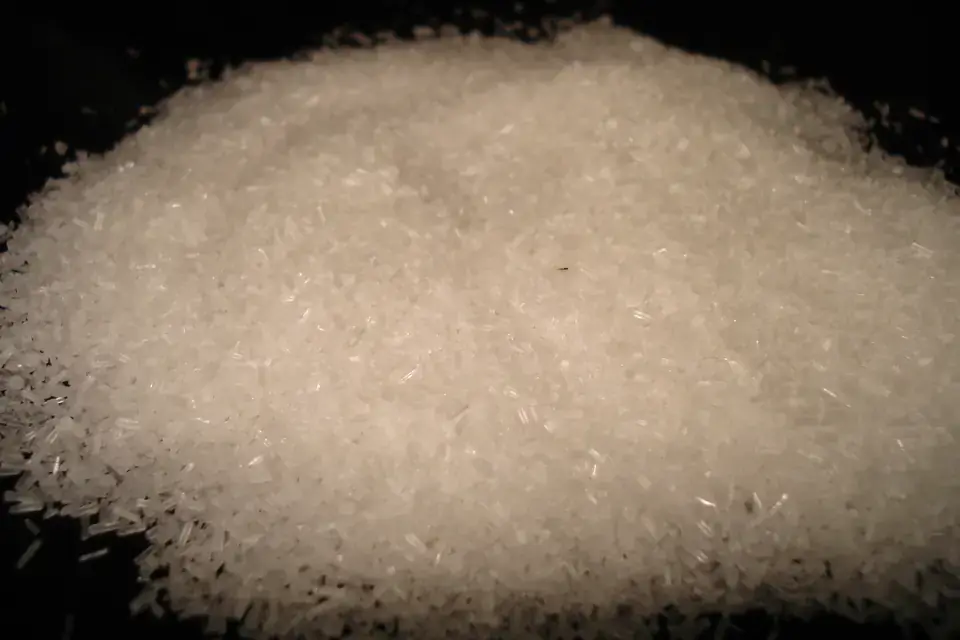
The savoury flavour enhancer behind crisps, stock cubes and instant noodles. E621 Monosodium glutamate (MSG) is doubtful. On German labels: Mononatriumglutamat.
Monosodium glutamate crystals
Why it is doubtful
Standard commercial MSG is grown by fermentation on a plant substrate, and that is Halal. The catch is that the label never names the substrate, so you cannot tell whether a given product took the standard route. It stays a question until a Halal mark or the manufacturer settles it. IFANCA lists E621 as questionable (Q2).
Halal or not depends on what it is made from
E621 is Mushbooh: Halal when it is fermented on a plant or Halal growth medium, not on a pork-derived one.
Made from
Verdict
Why
Fermentation of plant sugar (corn, sugar cane)
✅Halal
No animal involved
Fermentation on a Halal growth medium
✅Halal
The growth medium is Halal
Fermentation on a pork-derived growth medium
❌Haram
Pork-based growth medium
Halal-certified product
✅Halal
A certifier checked the source
Source not stated on the label
⚠️Mushbooh
Labels never name the growth medium
Scholarly view
Schools of law
Hanafi & MalikiNo school records a ruling on glutamate itself, so this is the general rule applied. Glutamate fermented from plant sugar on a clean medium is Halal. Where a pork-derived nutrient was used in the growth medium, the glutamate is separated from it and purified into a new substance (istihala, chemically changed into a new substance); these two schools accept such a transformation, though a Halal mark is the safer choice.
Leans permissible
Shafi'i & HanbaliGlutamate fermented from plant sugar on a clean medium is Halal. These schools do not accept that processing makes a pig-derived material acceptable again, so where the medium contained a pork-derived ingredient they advise avoiding it until a clean medium is confirmed.
Depends on source
Certification bodies
Dept. of Islamic Development Malaysia / Halal Food Authority, UKGlutamate made by fermenting plant sugar can be certified. The certifier checks the growth medium, the enzymes used to prepare it and the purification aids, because these can come from pigs.JAKIM — Halal Malaysia Portal ↗HFA FAQ ↗
Verify source
SANHAMSG (E621) is listed as Halal, made by fermentation using molasses from cane or beet sugar, or wheat protein. Monopotassium glutamate (E622) is listed as Halal, made synthetically from glutamic acid.SANHA — E621 ↗SANHA — E622 ↗
Permissible
MUI Fatwa Commission (Indonesia)On 16 December 2000 it declared one maker's MSG haram, because a processing aid in its fermentation (bacto-soytone) was found to contain a pig enzyme. On 19 February 2001 it declared the same MSG Halal once that aid had been replaced with a Halal, pure one (mameno), and urged Muslims to take care with anything doubtful.MUI Fatwa — MSG 2001 ↗
Depends on source
LPPOM MUI (Indonesia)MSG is made by fermenting molasses or corn starch with bacteria fed on a medium that includes a nitrogen source such as peptone, which can come from plants or from animals, pigs among them. The enzymes used to make the peptone, and any shared production line, must be free from pork, so it treats MSG as a critical product and points shoppers to certified ones.LPPOM MUI — MSG ↗
Verify source
Fatwa councils, scholars and other sources
Mufti Ebrahim Desai (askimam)MSG approved by SANHA is Halal. Where the maker's ingredients are unknown, find out whether anything haram, such as pork-based enzymes, is used, and abstain until that is known.askimam — MSG ↗
Depends on source
Darul Ifta Birmingham (Maulana Mustafa Umar)The seasoning is made from molasses and tapioca starch from sugarcane, both Halal, so it may be eaten as long as nothing else forbidden is added. It calls the claim that the product contained pig ingredients a myth, citing the Indonesian food authority's finding.Darul Ifta Birmingham — MSG ↗
Look for a product that names the source, says plant-based or vegan, or carries a Halal certificate. If nothing on the packet settles it, the manufacturer can tell you, and their answer is the only thing that turns E621 from a question into an answer.
A status here describes the additive in general, and a specific product can be different. The same number can be made from plant or animal material depending on the manufacturer, and the label does not say which.
Questions people ask
Is E621 Halal?
E621 Monosodium glutamate (MSG) is doubtful. Standard commercial MSG is grown by fermentation on a plant substrate, and that is Halal. The catch is that the label never names the substrate, so you cannot tell whether a given product took the standard route. It stays a question until a Halal mark or the manufacturer settles it. IFANCA lists E621 as questionable (Q2).
How do I know if the E621 in a product is Halal?
Only the manufacturer can tell you which source they used, unless the packet says plant-based, vegan, or carries a Halal certificate.
An additive's status describes the additive in general. What matters is the whole ingredient list on the packet in your hand.
This is information, not a fatwa. These statuses combine published scholarly positions with ingredient analysis, and they can be incomplete or out of date. For anything that matters, confirm with the manufacturer and with a qualified authority.