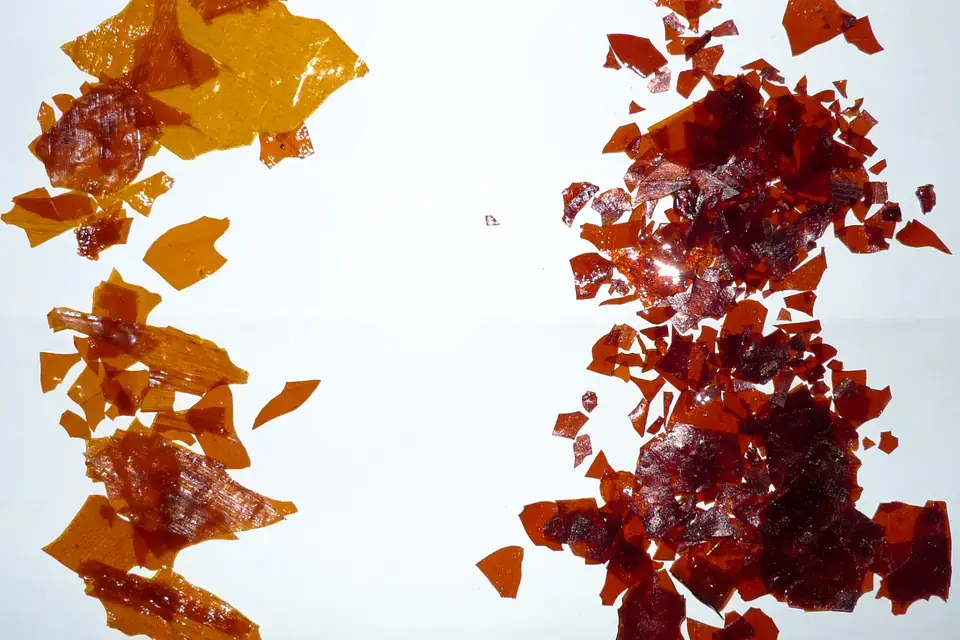
A natural resin secreted by the lac insect, used to make things shine. E904 (Shellac) is doubtful. On German labels: Schellack.
Shellac flakes, the resin of the lac insect
Why it is doubtful
Opinions on insect-derived substances differ; several Halal bodies permit it, which is exactly why we mark it doubtful rather than deciding for you.
Halal or not depends on what it is made from
E904 is Mushbooh: most scholars permit this insect resin as a secretion, like honey, but some do not, so we leave the call to you.
Made from
Verdict
Why
Resin secreted by the lac insect
⚠️Mushbooh
Scholars differ: a secretion like honey, or an insect product
Dissolved in alcohol for glazing
⚠️Mushbooh
Alcohol as a carrier needs checking
Scholarly view
Schools of law
HanafiHanafi scholars allow shellac in food and medicine. It is a secretion, not the insect's body, and is treated like honey; a small amount blended into a large mass is not considered repulsive and is hard to separate; and processing changes it into a new substance (istihala = chemically changed into something else). Some add that no insect particles may remain in it.SeekersGuidance — shellac (Hanafi) ↗
Permissible
MalikiA secretion, not the insect's body (reinforced by the honey analogy).
Leans permissible
Shafi'iIn this school insects may not be eaten, apart from locusts and tiny amounts that are hard to remove from food, and the body of a dead insect counts as impure (najis) in the relied-upon view. No Shafi'i text rules on shellac itself, which is a secretion rather than the insect's body; Indonesia's MUI, reasoning from Shafi'i legal manuals, holds it pure and Halal.SeekersGuidance — insects (Shafi'i) ↗
Doubtful
HanbaliMost Hanbali authorities hold that a creature without flowing blood, such as an insect, does not become impure (najis) when it dies, so the usual reason for caution does not apply. Insects themselves are still not eaten, and no Hanbali text rules on shellac itself; surveys of the schools treat the secretion like honey.
Many contemporary certifiersAccept shellac — a natural secretion requiring no slaughter.HalalLens ↗
Permissible
Fatwa councils, scholars and other sources
Honey-analogy (secretion) viewShellac is a secretion, not the insect's body — analogous to honey, which is explicitly permitted.HalalCodeCheck ↗
Permissible
halalblog.de"Classified as Halal by the overwhelming majority of scholars." Honey analogy (insect facilitates transformation) and secretion, not the insect itself (unlike carmine) — so comparable to vegetarian.halalblog.de — E904 Schellack ↗
Permissible
Sh. Assim al-HakeemEating insects or their secretions is not permitted by default, and rumours of "conspiracy" additives are baseless — sweets are Halal by default. But if the shellac has gone through a vigorous process that changes its physical and chemical make-up, as with gelatine or glycerine, it becomes a new substance and is Halal.YouTube — Assim al-Hakeem ↗
Doubtful
Only views with a published source are listed. Our app shows E904 as Mushbooh unless the label or the maker settles the source.
Look for a product that names the source, says plant-based or vegan, or carries a Halal certificate. If nothing on the packet settles it, the manufacturer can tell you, and their answer is the only thing that turns E904 from a question into an answer.
A status here describes the additive in general, and a specific product can be different. The same number can be made from plant or animal material depending on the manufacturer, and the label does not say which.
Questions people ask
Is E904 Halal?
E904 (Shellac) is doubtful. Opinions on insect-derived substances differ; several Halal bodies permit it, which is exactly why we mark it doubtful rather than deciding for you.
How do I know if the E904 in a product is Halal?
Only the manufacturer can tell you which source they used, unless the packet says plant-based, vegan, or carries a Halal certificate.
An additive's status describes the additive in general. What matters is the whole ingredient list on the packet in your hand.
This is information, not a fatwa. These statuses combine published scholarly positions with ingredient analysis, and they can be incomplete or out of date. For anything that matters, confirm with the manufacturer and with a qualified authority.